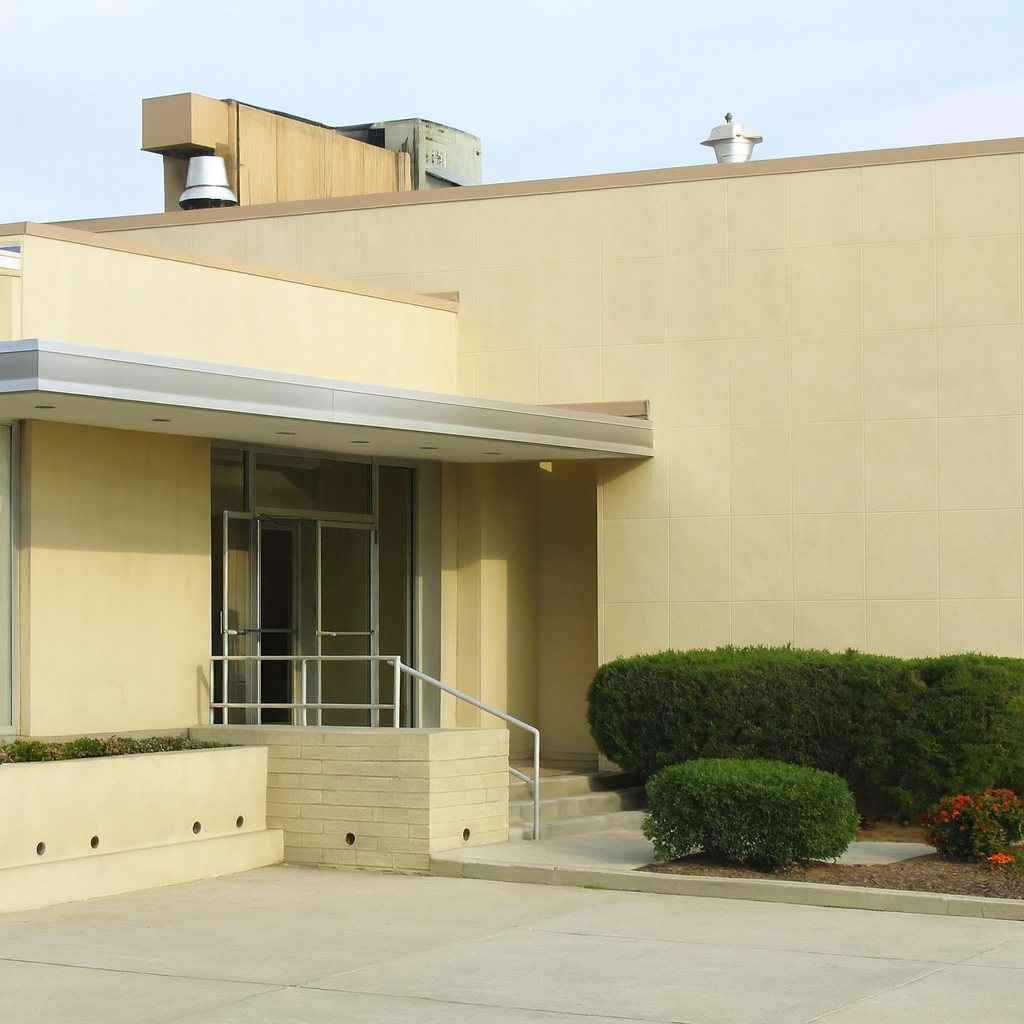
BREAKDOWN ON HOW STRAIGHT INC. OPERATED
the PROGRAM
Straight, Inc. Program Overview — the history, phases, steps, and daily structure.
Straight, Inc. — National Overview
Founded in April 1976 by Orlando-area parents, Straight, Incorporated was a controversial adolescent drug rehabilitation program operating from 1976 to the early 1990s. It targeted youth aged 12–22 (sometimes younger) and expanded to cities including Orlando, Cincinnati, Southern California, Atlanta, Springfield, Dallas, and Boston.
Built on the idea that peer pressure causes drug use—and peer pressure can cure it, Straight drew heavily from Synanon and The Seed. It featured rigid, peer-led confrontational "rap" sessions, forced confessions, and public shaming. It adapted a condensed 7-step AA model, but removed voluntary/spiritual elements for strict institutional control.
Despite early claims of high success, Straight faced intense criticism and multiple lawsuits for isolation, humiliation, psychological abuse, false imprisonment, denial of medical care, and enrolling youth with no drug history. Media exposés and survivor accounts led to closures amid legal pressure. Today, survivor networks document its history and advocate against similar coercive models.

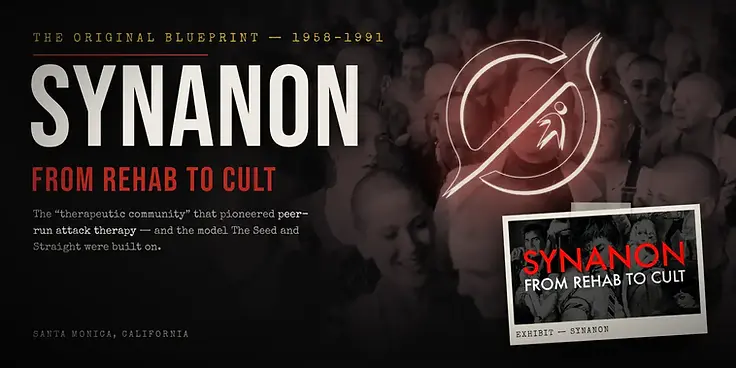
Synanon Program History
Synanon, founded in 1958 by Charles E. "Chuck" Dederich Sr. in Santa Monica, California, began as a pioneering drug rehabilitation program for heroin addicts. Originally called Tender Loving Care, it was one of the first therapeutic communities emphasizing peer-run "attack therapy" through the "Synanon Game"—intense, confrontational group sessions where members verbally assaulted each other to break down defenses and excuses.
Dederich, a former alcoholic who found AA insufficiently confrontational, created Synanon as a residential alternative. Addicts lived together in abstinence, with no professional therapists—recovery relied on mutual peer accountability, hard labor, isolation from outside influences, and brutal honesty in groups.
Controversies and Abuses
- Forced physical alterations: women required to shave their heads; mass vasectomies and abortions encouraged or mandated.
- Family destruction: children separated from parents; partners reassigned by leadership.
- Extended "Games": sessions lasted up to 72 hours, involving sleep deprivation and relentless verbal abuse.
- Paramilitary enforcement: the "Imperial Marines" carried out beatings, intimidation, and surveillance; over $300,000 in weapons stockpiled.
- Terrorism: in 1978, members placed a de-rattled rattlesnake in the mailbox of attorney Paul Morantz, leading to attempted-murder convictions.
- Child abuse and brainwashing: institutionalized abuse, bribery attempts, and gun law violations investigated.
Synanon disbanded in 1991 after IRS revocation of tax-exempt status, financial scandals, and criminal convictions. It is widely regarded as a dangerous cult that pioneered coercive "tough love" models influencing later programs—including The Seed and Straight, Inc.
Addicts lived together in abstinence, with no professional therapists — recovery relied on mutual peer accountability, hard labor, isolation from outside influences, and brutal honesty in groups.


The Seed Program History
The Seed was a controversial youth drug rehabilitation program that operated in South Florida from 1970 to 2001. Founded by former comedian and recovering alcoholic Art Barker, it was directly modeled after Synanon's confrontational methods and targeted adolescents (often as young as 12) suspected of drug use—even those with no actual history.
The Seed used aggressive confrontation, intimidation, verbal abuse, sleep deprivation, and restricted bathroom access to "break down" teens and rebuild them as "Seedlings." Sessions were all-day marathons of peer pressure and public shaming. It received federal funding in the early 1970s and was highly publicized at the time.
In 1974, a U.S. Senate investigation compared The Seed's techniques to North Korean communist brainwashing of POWs. Federal funding was cut, and the program shrank dramatically, continuing in reduced form until closing in 2001. Many parents whose children attended The Seed went on to found Straight, Inc. in 1976, borrowing its core structure, rap sessions, and peer-enforcement model.
- —Synanon (1958) pioneered attack therapy and the confrontational "Game."
- —The Seed (1970) brought that model to adolescents, backed by federal funding.
- —Straight (1976) was founded by Seed parents and inherited the same structure.

The 5 Phases of Straight
First Phase — Newcomer
Minimum 14 Days, often much longer
Focus Complete breakdown of prior identity and resistance; forced emotional exposure.
Key Experiences
- Constant supervision by Oldcomers; escorted everywhere (including bathroom)
- Sat in "open" position with hands visible
- Required to "share" in raps about guilt and past wrongs
Restrictions
- No books/magazines (except program lit), no TV/radio/music
- No mail/phone, no eye contact with outsiders
- Daily strip searches, limited/earned family contact only in program setting
Advancement Must demonstrate total compliance, emotional breakdowns ("getting honest"), and acceptance of program authority; often delayed for "bad attitude".
Second Phase — Family
No minimum, often months
Focus Rebuilding family obedience; proving program values at home.
Key Experiences
- Return to family home or foster placement
- Increased chores/responsibilities; supervised by Oldcomers
- Daily building attendance
Restrictions
- Allowed belt; Bible reading permitted
- Phone limited to "Dime Therapy" (short calls to approved people)
- No dating, no outside friends, no unsupervised time
Advancement Show improved family dynamics, full obedience, and emotional "growth" via raps.
Third Phase — Achievement
No minimum
Focus Reintegrate school/work while maintaining strict compliance.
Key Experiences
- Attend school/job daily, return to building immediately after
- Report all outside interactions/temptations in raps
Restrictions
- TV/radio/books allowed; wear watch
- Must maintain grades/performance
- Any "slips" or unreported contact could result in demotion or restraint
Advancement Demonstrate stability, leadership potential, and continued Moral Inventories.
Fourth Phase — Transition
Minimum 90 Days
Focus Develop healthy leisure and limited friendships; prepare for independence.
Key Experiences
- Attend building 4 days/week; full phone/mail
- Form supervised friendships; earn some unsupervised time
Restrictions
- Continue inventories
- Model behavior for lower phases while gradually withdrawing
Advancement Show emotional consistency and leadership readiness (min. 90 days).
Fifth Phase — Service & Leadership
Minimum 60 Days
Focus Assume supervisory roles; prepare for graduation ("7th Stepping").
Key Experiences
- Supervise Newcomers; part of chain of command
- Relay requests to staff
Restrictions
- Still no dating
- Attend building 3 days/week; full compliance required
Advancement Only the Director could approve 7th Stepping after min. 60 days.
The program’s own diagram of what each phase works on: self, family, achievement, leisure, and service.
Archive material contributed anonymously.
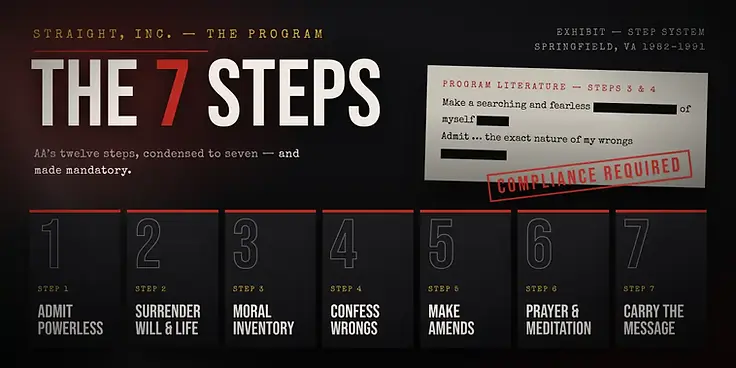
The 7 Steps of Straight
- 1Admit I am powerless over drugs and come to believe that a power greater than myself can restore me to sanity.
- 2Make a decision to turn my will and life over to the care of God, as I understand Him.
- 3Make a searching and fearless moral inventory of myself daily.
- 4Admit to God, myself, and another human being the exact nature of my wrongs immediately.
- 5Make direct amends to such people wherever possible except when to do so would injure them, myself, or others.
- 6Seek through prayer and meditation to improve my conscious contact with God, as I understand Him, praying only for the knowledge of His will for me and the power to carry that out.
- 7Having received the gift of awareness, practice these principles in all my daily affairs and carry the message to all I can help.


Inside the Warehouse
The warehouse was not just a building. It was a world with its own gravity — a sealed environment where time stretched, sound carried, and every movement was watched.
The Day That Never Ended
4:47 AM
Morning always arrived too soon, crashing into me before I had any chance to feel ready for it. Most days I was jolted awake in the dark, long before sunrise, already tensing for whatever waited at the building. Host Homes were scattered far from there—sometimes more than an hour away—so exhaustion was built into the day from the start. With only a few hours of sleep, my thoughts would start racing immediately, dread settling in before my feet even touched the floor. The car rides in were usually silent. Outside the window, the world seemed to be easing into another ordinary morning, and all I wanted was to belong to a normal, boring day instead of heading back into that place.
6:30 AM
Inside, the fluorescent lights were already blazing—they stayed on from open to close. Rows of molded plastic chairs faced the staff platform. Newcomers sat in the front row, Oldcomers behind them, every seat assigned and strictly enforced.
9:00 AM
By the time the first rap session exploded to life, the building felt fully awake. The sound hit like a physical blow—clapping, chanting, voices rising in perfect unison. It was too loud to think, too fast to absorb, too relentless to push back against. I realized then that the day wasn't just long; it was designed to feel endless, a loop of pressure and performance that stripped away any sense of time moving forward.
too loud to think, too fast to absorb, too relentless to push back against
The room turned on one person — the group in session. The day wasn't just long. It was designed to feel endless — a loop of pressure and performance that stripped away any sense of time moving forward.
9:00 PM
As the hours dragged on, the truth became clearer, hidden in the spaces between every rule and every confrontation: in this place, the day never truly ended. It only changed form.
in this place, the day never truly ended. It only changed form.
11:58 PM

Rules Became Weapons
No warning. No appeal.
Survival - One Posture at a Time
I still remember the chair. Hard plastic, no cushion, hooked together. We sat upright for hours—no slouching, no leaning, no crossing your legs. If your posture slipped, someone would call you out. If you reacted, you were “drifting.” And if you drifted, you were punished.
At Straight, Inc., rules weren’t just guidelines. They were the air we breathed. Every movement, every word, every thought was regulated. You couldn’t whisper. You couldn’t joke. You couldn’t look around the room. You couldn’t even close the bathroom door.
Total Control, Total Surveillance
From the moment you entered Phase 1, you lost everything—privacy, autonomy, even your name. You were a “newcomer.” You couldn’t speak unless called on. You couldn’t go to school. You couldn’t be alone. You lived with a host family who watched you 24/7. No freedom of movement. You were escorted by the belt loop everywhere you went.
The Belt Loop
Newcomers were held by the belt loop by an older client everywhere they went. A hand hooked through the back of your jeans was the oldest rule of the day: into group, to the bathroom, through the food line, out to the van. You were never, for a second, out of someone’s grip.





Every day was a test. Every rule was a trap.
We were forced to “motivate”—waving our arms wildly to get permission to speak. We had to confess every thought, no matter how private. If you didn’t disclose something, they said you were “withholding.” That was lying. That was dangerous.
Enforcement by Peers
Staff didn’t need to enforce the rules. We did it to each other.
If someone broke a rule, we were expected to confront them. Loudly. Aggressively. In group, we’d stand and shout, accuse, demand confessions. If you resisted, you were labeled “manipulative.” If you cried, you were “brown noser and a kiss ass.” If you denied anything, you were “in denial.”
Sometimes, we restrained each other. Sat on each other. Older clients were expected to physically manage newcomers, often believing they were fulfilling program expectations.
Punishment Was Immediate
Break a rule, and you were “back on First Phase.” No warning. No appeal.
That meant losing every privilege you’d earned. No phone calls. No mail. No contact with anyone outside the group. You were stripped of status, isolated, humiliated. Sometimes for weeks. Sometimes for months.
The Rules Were the Program
Every group session was a battlefield. You had to “share” dramatically. You had to confront others. You had to accept confrontation without flinching. If you hesitated, you were “resistant.” If you disagreed, you were “not working your program.”
We learned to perform pain. To confess things we didn’t believe. To say what they wanted to hear.
Because the alternative was punishment.
The alternative was Phase 1.
Straight, Inc. didn’t just enforce rules—it built its entire system around them. The rules were designed to:
- Break down your identity
- Extract confessions
- Enforce conformity
- Prevent escape
- Create a hierarchy of control
Older clients controlled newer ones. Fifth phasers enforced the rules. Everyone was watching everyone else.
And when the rules broke you, they said you were finally being honest.
The rules handed to every new parent: mandatory open meetings, dress, seating, and no eye games with your child.
Archive material contributed anonymously.Rules for daily living at home or in group, issued under Second Chance, Inc.
Archive material contributed anonymously.No Talking Behind Backs
Straight enforced a strict rule that no client could speak about another client unless that person was physically present.
On paper, it sounded like a rule against gossip. In practice, it became a tool of surveillance and control. Any private comment, whispered concern, or even a neutral observation made outside someone’s presence was labeled “talking behind their back” — a punishable offense.
Instead of protecting anyone, it created an atmosphere where the only “safe” speech was public confession or accusation, and anything else could be used against you.
HEADGAMES - Policed By Paranoia
I never knew when I’d broken a rule. That was the worst part. Not the shouting. Not humiliation. Not even the threat of being thrown back to First Phase. It was not knowing.
The paranoia crawled under my skin the second I woke up. Every breath felt like a test I didn’t know I was taking. Every movement felt like it might be the wrong one. I’d sit in that hard plastic chair, spine locked, eyes forward, pretending I understood the rules while my brain spun in circles trying to guess what invisible line I might’ve crossed.
Because in Straight, you didn’t get told you broke a rule. You got ambushed by it. One second you were fine. The next, the room exploded.
Dozens of voices slamming into you at once—accusing, dissecting, demanding. You didn’t even know what you’d done. You just knew you were the target now, and the only way out was to confess something, anything, everything.
The fear didn’t hit all at once. It simmered. It built. It wrapped itself around your ribs and squeezed until you couldn’t breathe.
Hours could pass like that—waiting for the blast. Waiting for the group to turn. Waiting for someone to shout your name and drag you into the center of the storm.
And the whole time, your mind raced: Did I look around the room? Did I sigh too loud? Did I think something I wasn’t supposed to think? Did someone decide I looked “drifty”? Did I forget to motivate hard enough? Did I blink wrong?
That was the head game. The constant dread. The constant scanning. The constant second-guessing of every breath you took.
Straight didn’t need to punish you to control you. It just needed you terrified of punishment.
The fear did the rest.
It hollowed you out. It rewired your instincts. It made you police harder than they ever could.
Because once that paranoia took hold—once you lived in that state of waiting, bracing, anticipating the next explosion—you weren’t just in the program.
The program was in you.

No License, No Oversight
Straight, Inc. ran on a model with no license behind it and no outside review over it. No clinical authority signed off on the confinement, the confrontations, or the restraints survivors describe, and the treatment itself was peer enforcement — carried out by other teenagers under staff supervision.
The two exhibits below are the record it left: a program that was never a licensed rehab, and the leaflet it used in place of treatment.
Evidence board
Daily Group Structure
Morning Routine
Clients were transported from host homes early each morning and escorted into the building under strict supervision. Newcomers were never allowed to walk alone and were required to maintain silence and proper posture upon arrival.
Group Sessions ("Raps")
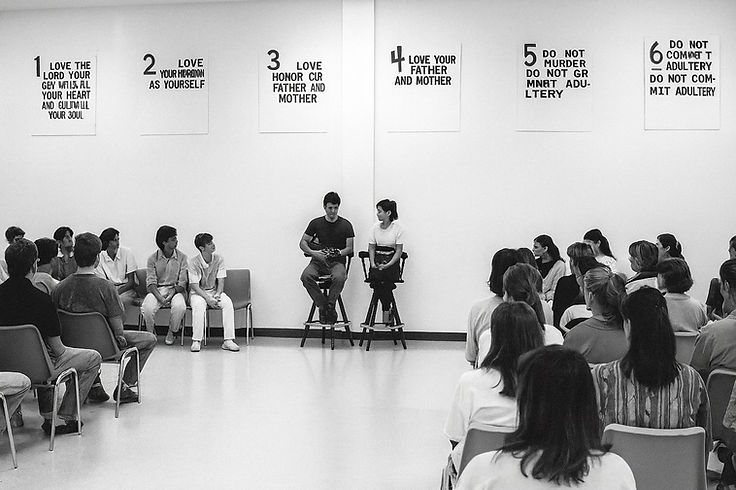
Most of the day was spent in long, intense group meetings called raps. These sessions were the core engine of the program—peer-led confrontations in which clients were pressured to confess, comply, and break down. The structure of the day was designed to leave no unstructured time and no privacy.
The Events That Shaped It
A Calculated Bid for National Credibility
During the 1980s, Straight, Inc. aggressively pursued political validation to strengthen its public image and expand its reach. Few moments carried more symbolic weight than the high-profile visits from First Lady Nancy Reagan and Princess Diana to the Straight, Inc. facility in Springfield, Virginia. Their appearances gave the program a presidential and even international aura of legitimacy at a time when survivors were already reporting coercive and abusive conditions inside.
Straight’s leadership understood the power of optics. The Springfield facility — already under scrutiny for its harsh methods — became a stage for political theater. Federal drug officials, including Robert DuPont and Carlton Turner, were deeply intertwined with Straight’s leadership and helped facilitate high-visibility endorsements that could overshadow growing allegations of abuse.


Presidential power meets a dangerous program
Within this strategy, Nancy Reagan’s visit to the Springfield warehouse was a major victory for Straight. As the face of the “Just Say No” campaign, her presence suggested that Straight represented the gold standard of youth drug treatment. The program leveraged her visit in fundraising, recruitment, and public relations materials, presenting it as proof of federal approval.
Vice President Bush’s public praise
Nancy Reagan was not the only endorsement the program kept in circulation. Vice President George H. W. Bush praised Straight, Inc. on camera as well, and the program held that tape the way it held the invitation — as proof that the federal government stood behind the model, at a moment when survivors were describing what the model did.
Princess Diana inside the Springfield facility — digitally restored.
Archive material contributed anonymously.The board announcing a national record: one hundred and thirty new admissions in February 1985.
Archive material contributed anonymously.How Straight Sold Itself
Straight's growth depended on publicity it could shape: fact sheets written by the program, advertising for its intake line, and newspaper coverage held up as proof that the model worked.
Newspaper illustration by Martin Rhodes on the program’s public reach into families.
Archive material contributed anonymously.The program’s own press sheet: fees, completion rates, and the demographics it sold to the public.
Archive material contributed anonymously.The sign advertising the intake line: assessments, urinalysis, family therapy, aftercare.
Archive material contributed anonymously.The Parents' Program
Parents were not spectators. Attendance at open meetings was mandatory, speaking happened on cue into a microphone in front of hundreds of people, and a child's progress reached the family as a typed report.
The role-play script handed to parents before they spoke into the microphone in front of the group.
Archive material contributed anonymously.A client’s progress report, day 17 — identifying details redacted.
Archive material contributed anonymously.