
PrologueThe Label
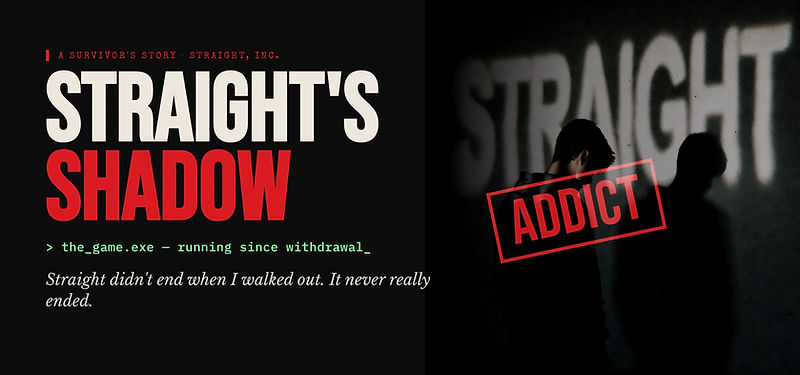
In Straight you didn’t get a diagnosis. You got a label.
Addict.
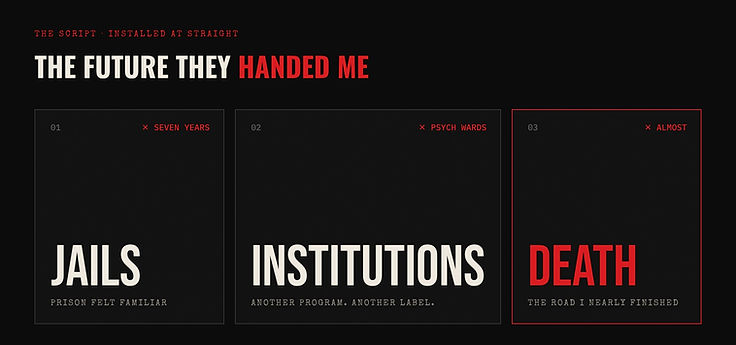
And with the label came a future:
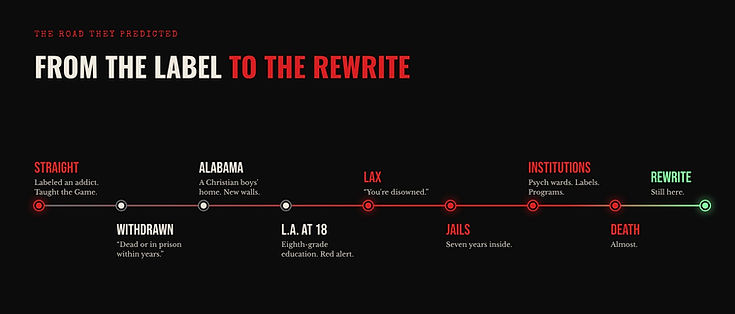
JAILS. INSTITUTIONS. DEATH.
Straight didn’t end when I walked out. It never really ended.
The Game didn’t just teach me rules. It rewired me. Fear, hypervigilance, permanent survival mode: none of those were quirks or character defects. They were code, burned into my nervous system. Everything that came after wasn’t random bad luck. It was the output of conditioning that never shut off.
IThe Verdict
The day my parents withdrew me from the program, I was pulled out of Group and walked to a small cubicle office.
An executive staff member and my parents were already seated, waiting. My parents looked terrified.
Dean slid a sheet of paper across the desk to sign.
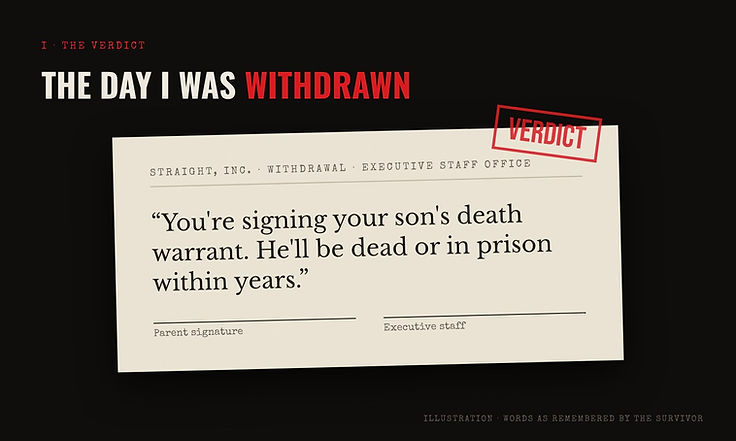
“You’re signing your son’s death warrant. He’ll be dead or in prison within years.”

Straight had already drilled obedience into me:
Authority = truth. Instinct = lies. Fear = reality.
So I believed the verdict. I took it in like gospel.
IINew Walls
My parents, still afraid, drove me to a Christian boys’ home in Alabama.
I walked in and asked the only question the Game had left me with:
“What’s the program? Where are the steps?”
The staffer slammed a thick Bible on the desk.
“Boy, that’s the only program you’ll ever need.”
The walls and the scriptures were new. The fear behind them was the same, and so was my survival wiring.
09-shadow-the-crossroads
Tall plate beside chapter II, New Walls.
IIILos Angeles
I landed in L.A. at eighteen with an eighth-grade education. I knew almost nothing about how to live, and my nervous system was locked on red alert.
Every shadow held danger. Every quiet moment carried judgment.
The God I’d been taught to pray to stayed silent, and in Straight, silence meant failure. So I doubled down. I worked my “program” harder, and everything kept getting worse.
Then it all came apart at once.
That’s how I ended up at LAX, holding a one-way ticket and the last message my family would send:
“Don’t write. Don’t call. You’re disowned.”
IVThe Firmware
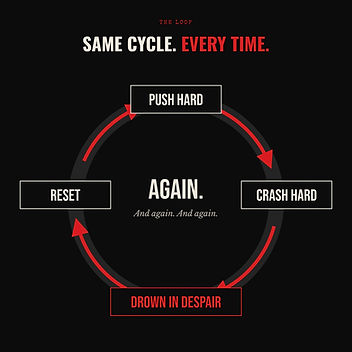
The cycle was the same every time: push hard, crash hard, drown in despair, reset. Then again, and again.

The triggers were everywhere:
| Trigger | Response |
|---|---|
| Touch | flinch |
| Affection | suspicion |
| Connection | threat analysis |
| Family | loaded unpredictability |
| Raised voices | instant racing heart |
| Sudden movement | full-body freeze |
| Closed doors | entrapment |
| Silence | punishment |
| Eye contact | exposure |
| “What’s wrong?” | interrogation |
| Kindness | bait |
| Any conflict | incoming attack |

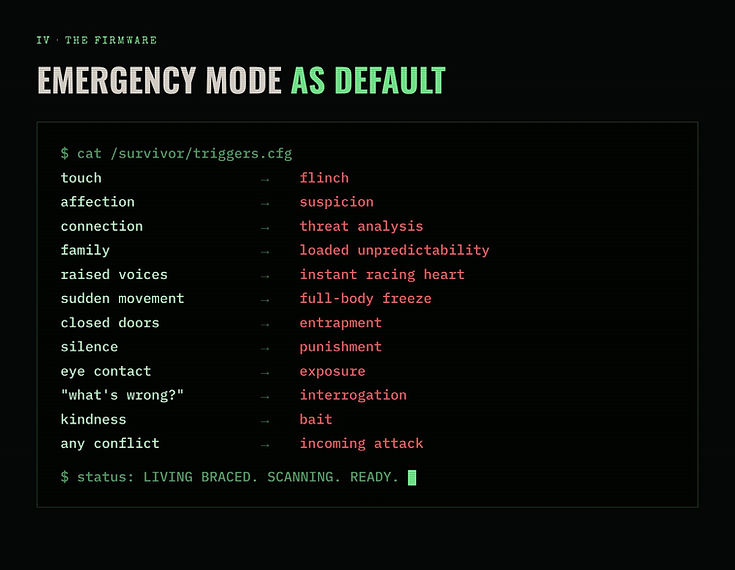
My body reacted before I could think. I lived braced, scanning, ready, long after the war was supposed to be over.
This wasn’t drama or defiance. It was firmware: emergency mode as my default setting.
VJails
I arrived exactly where they predicted, and it wasn’t destiny. It was design.
Seven years inside.
Prison felt familiar. Its rules lined up with Straight’s: never show weakness, never be the mark. Predators exploit hesitation the same way staff once did.
Several Straight brothers turned up in there too. Our greeting was always the same:

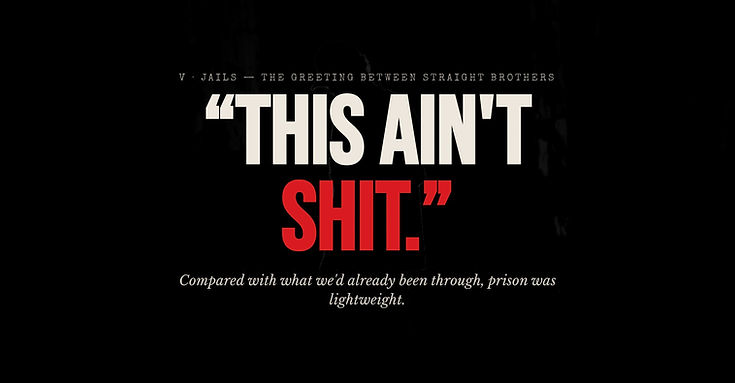
Compared with what we’d already been through, prison was lightweight.
Fight-or-flight, sharpened to a point, was an asset in that place. But it poisoned everything soft.
VIInstitutions
Psych wards. Then the bipolar label. It fit the chaos of a body built for threat. The medications spun new spirals.
Twelve-step rooms swallowed me whole. Every relapse got blamed on “not working the program hard enough.” So I worked harder. Straight had carved that loop deep.
But the harder I worked, the more rage built inside me. Mainstream AA became another rigid orthodoxy, no different from the religion I’d been force-fed. It was one more voice telling me the problem was me, and one more system that couldn’t touch the real wound.
Programs built on control can’t heal damage engineered by control.
VIIDeath
Addiction. Suicide attempts. Alcohol became blackout, the only ceasefire I could find.
The wreckage spread outward. I burned every bridge, with family and with friends. I didn’t know how to receive care without scanning for the trap. Love felt like incoming fire. Trust felt like surrender.
Jails. Institutions. Death. The roadmap had been installed in me as a kid, and I followed it almost all the way to the end.
VIIIThe Truth

I wasn’t broken. I was conditioned, on purpose.
My hypervigilance wasn’t a flaw. It was firmware Straight installed in me. The Game didn’t expire when I left. It moved into every relationship, every collapse, every attempt to rebuild.
That’s the long tail. That’s what happens when survival code is the only operating system you’ve ever run.
IXThe Rewrite
For years I accepted the label: addict, felon, lost cause, prophecy fulfilled.
But the evidence tells a different story.
I wasn’t born defective. I was a child trained to brace for an attack that could come from anywhere, at any time.
Understanding that flipped the switch. The Game stopped being my identity and started being my explanation. It gave words to decades of pain, context to the chaos, and mercy to the reflexes I used to hate.
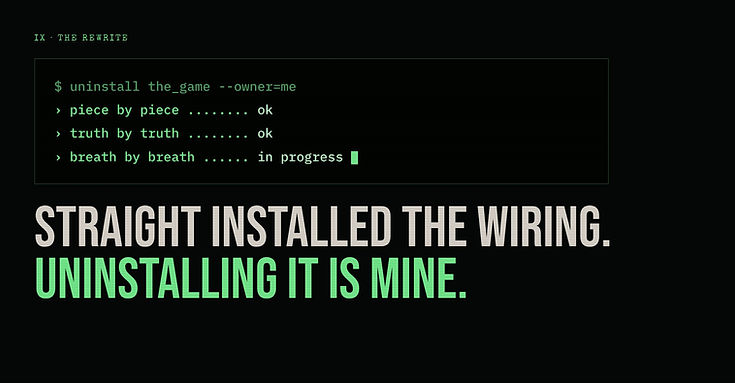
Straight installed the wiring. Uninstalling it is mine.
Piece by piece. Truth by truth. Breath by breath.
The Game became my operating system. Now I’m learning to overwrite it, and that is the one outcome Straight never scripted.

I survived long enough to rewrite the ending. And I’m still here, telling the story.
Part II — The Long Return to Myself
Part II — The long return to myself

XThe Bottle
For several years I wrapped myself in a bottle.
I drank alone and raged in circles, trying to drown out what Straight had done to me. It was the only escape I had, the only way to quiet the noise they left behind.
XIWithout Their Script
And then, for the first time, I could look at my life without their slogans, their rules, their threats.
When I did, the pieces finally made sense. They weren’t proof that I was broken. They were the predictable fallout of a system built on coercion and psychological control.
Reclaiming myself meant letting the truth stand on its own.
It meant letting my own voice come back, quiet at first, but mine.
XIIWhat Came Back
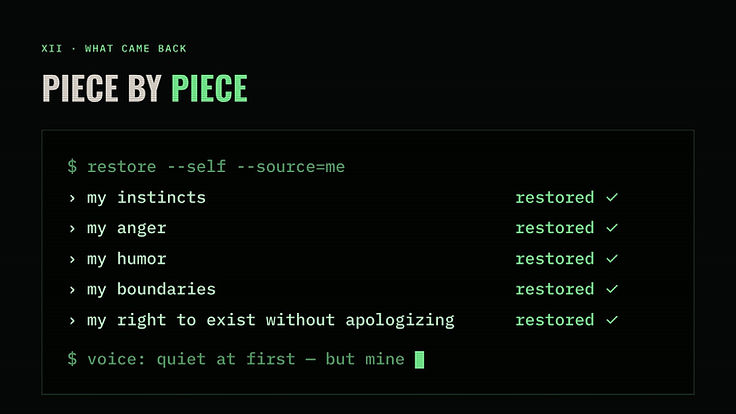
Piece by piece, I found parts of myself I thought were gone:
my instincts · my anger · my humor · my boundaries · my right to exist without apologizing

And slowly I understood something I had never been allowed to believe:
I wasn’t the broken one. I was the one who survived.

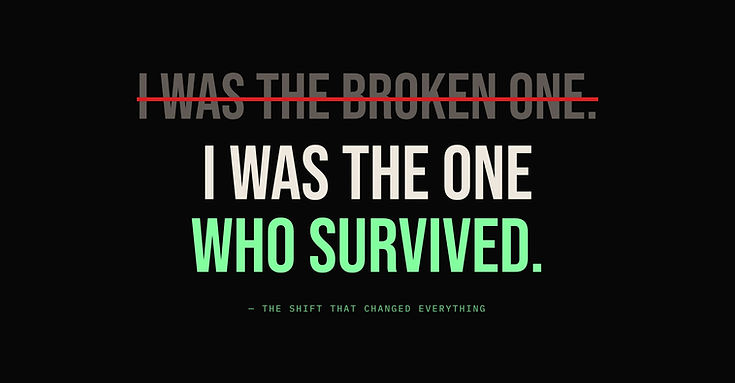
That shift was quiet, but it changed everything, and it became the foundation for all that came next.
It wasn’t a return to who I was before Straight. It was the beginning of who I could finally become, without them writing the script.
XIIIThe Program Still Running
Because the truth is this:
Straight didn’t just shape my teenage years. It wired itself into every part of my life: how I reacted, how I trusted, how I loved, how I survived. It lived in my nervous system, in my instincts, in split-second reactions I couldn’t control.
And the worst part?
I didn’t even know it was there.
It took twenty-five years just to see the Program still running my life from the inside. Twenty-five years before I could even name what happened to me.
XIVThe Deprogramming
Then came the real work.
Fourteen more years of peeling back conditioning so deep it felt biological.
Fourteen years of fighting reflexes and beliefs that weren’t mine.
Fourteen years of letting go of shame that was never mine to carry.
That’s the scale of it. That’s how deep the programming went. That’s what it means to survive something designed to own you long after you walk out the door.

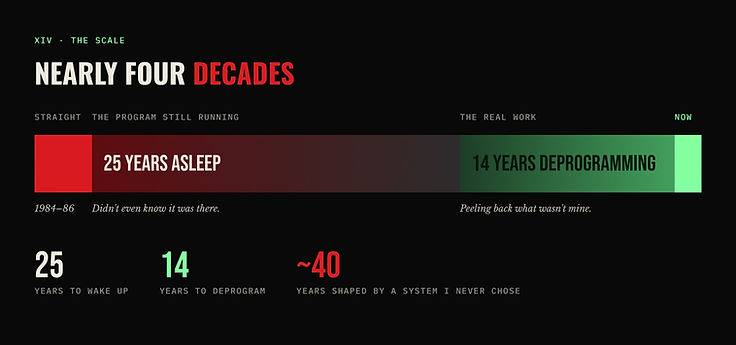
25 years to wake up. 14 years to deprogram. Nearly four decades shaped by a system I never chose.
EpilogueBreak Free
And yet, here I am.
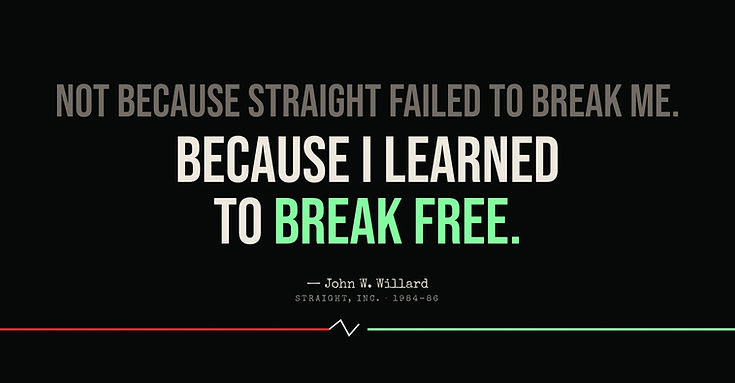
Not because Straight failed to break me.
Because I finally learned to break free of Straight.
— John W. Willard, Straight, Inc. · 1984–86

After the story
If you’re a Straight survivor and any of this is yours too, you’re not alone.
Share your story →If you’re struggling right now, you can call or text 988 (Suicide & Crisis Lifeline, U.S.) any time.